Early life and work
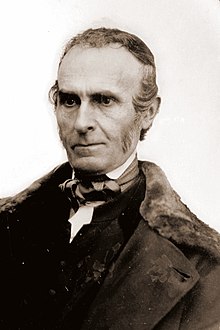
John Greenleaf Whittier was born to John and Abigail (née Hussey) Whittier at their rural homestead in Haverhill, Massachusetts, on December 17, 1807.[1] His middle name is thought to mean feuillevert, after his Huguenot forebears.[2] He grew up on the farm in a household with his parents, a brother and two sisters, a maternal aunt and paternal uncle, and a constant flow of visitors and hired hands for the farm. As a boy, it was discovered that Whittier was color-blind when he was unable to see a difference between ripe and unripe strawberries.[3]
The farm was not very profitable, and there was only enough money to get by. Whittier himself was not cut out for hard farm labor and suffered from bad health and physical frailty his whole life. Although he received little formal education, he was an avid reader who studied his father’s six books on Quakerism until their teachings became the foundation of his ideology. Whittier was heavily influenced by the doctrines of his religion, particularly its stress on humanitarianism, compassion, and social responsibility.
Whittier was first introduced to poetry by a teacher. His sister Mary Whittier sent his first poem, “The Deity”, to the Newburyport Free Press without his permission, and its editor, William Lloyd Garrison, published it on June 8, 1826.[4] Garrison as well as another local editor encouraged Whittier to attend the recently opened Haverhill Academy. To raise money to attend the school, Whittier became a shoemaker for a time, and a deal was made to pay part of his tuition with food from the family farm.[5] Before his second term, he earned money to cover tuition by serving as a teacher in a one-room schoolhouse in what is now Merrimac, Massachusetts.[6] He attended Haverhill Academy from 1827 to 1828 and completed a high school education in only two terms.
Whittier received the first substantial public praise for his work from critic John Neal via Neal’s magazine The Yankee in 1828.[7] Whittier valued the opinion of the older and more established writer, pledging that if Neal did not like his writing, “I will quit poetry, and everything also of a literary nature, for I am sick at heart of the business.”[8] In an 1829 letter, Neal told Whittier to “Persevere, and I am sure you will have your reward in every way.”[9] Reading Neal’s 1828 novel Rachel Dyer inspired Whittier to weave New England witchcraft lore into his own stories and poems.[10]
Garrison gave Whittier the job of editor of the National Philanthropist, a Boston-based temperance weekly. Shortly after a change in management, Garrison reassigned him as editor of the weekly American Manufacturer in Boston.[11] Whittier became an outspoken critic of President Andrew Jackson, and by 1830 was editor of the prominent New England Weekly Review in Hartford, Connecticut, the most influential Whig journal in New England. He published “The Song of the Vermonters, 1779” anonymously in The New-England Magazine in 1838. The poem was mistakenly attributed to Ethan Allen for nearly sixty years. Whittier acknowledged his authorship in 1858.
During the 1830s, Whittier became interested in politics, but after losing a congressional election at age 25, he suffered a nervous breakdown and returned home. The year 1833 was a turning point for Whittier; he resurrected his correspondence with Garrison, and the passionate abolitionist began to encourage the young Quaker to join his cause.
In 1833, Whittier published the antislavery pamphlet Justice and Expediency,[12] and from there dedicated the next twenty years of his life to the abolitionist cause. The controversial pamphlet destroyed all of his political hopes, as his demand for immediate emancipation alienated both Northern businessmen and Southern slaveholders, but it also sealed his commitment to a cause that he deemed morally correct and socially necessary. He was a founding member of the American Anti-Slavery Society and signed the Anti-Slavery Declaration of 1833, which he often considered the most significant action of his life.
Whittier’s political skill made him useful as a lobbyist, and his willingness to badger anti-slavery congressional leaders into joining the abolitionist cause was invaluable. From 1835 to 1838, he traveled widely in the North, attending conventions, securing votes, speaking to the public, and lobbying politicians. As he did so, Whittier received his fair share of violent responses, being several times mobbed, stoned, and run out of town.
From 1838 to 1840, he was editor of the Pennsylvania Freeman in Philadelphia,[13] one of the leading antislavery papers in the North, formerly known as the National Enquirer. In May 1838, the publication moved its offices to the newly-opened Pennsylvania Hall on North Sixth Street, which was shortly after burned by a pro-slavery mob.[14] Whittier continued to write poetry, and nearly all of his poems then dealt with the problem of slavery.
In 1838, Charles G. Atherton of New Hampshire presented five resolutions that were adopted and created a new resolution that barred Congress from discussing petitions that mentioned bringing slavery to an end. Congress approved them on December 12, 1838, which became known as the “Atherton Gag”; Whittier referred to Atherton in one of his many abolition poems as “vile” by having allied himself so closely with his fellow Democrats from pro-slavery South.[15] It was not until 1844 the House rescinded that gag rule on a motion made by John Quincy Adams.
By the end of the 1830s, the unity of the abolitionist movement had begun to fracture. Whittier stuck to his belief that moral action apart from political effort was futile. He knew that success required legislative change, not merely moral suasion. That opinion alone engendered a bitter split from Garrison,[16] and Whittier went on to become a founding member of the Liberty Party in 1839.[13] In 1840, he attended the World Anti-Slavery Convention in London.[17] By 1843, he was announcing the triumph of the fledgling party: “Liberty party is no longer an experiment. It is vigorous reality, exerting… a powerful influence.”[18] Whittier unsuccessfully encouraged Ralph Waldo Emerson and Henry Wadsworth Longfellow to join the party.[19] He took editing jobs with the Middlesex Standard in Lowell, Massachusetts, and the Essex Transcript in Amesbury until 1844.[13] While in Lowell, he met Lucy Larcom, who became a lifelong friend.[20]
In 1845, he began writing his essay “The Black Man” which included an anecdote about John Fountain, a free black who was jailed in Virginia for helping slaves to escape. After his release, Fountain went on a speaking tour and thanked Whittier for writing his story.[21]
Around then, the stresses of editorial duties, worsening health, and dangerous mob violence caused Whittier to have a physical breakdown. He went home to Amesbury and remained there for the rest of his life, ending his active participation in abolition. Even so, he continued to believe that the best way to gain abolitionist support was to broaden the Liberty Party’s political appeal, and Whittier persisted in advocating the addition of other issues to its platform. He eventually participated in the evolution of the Liberty Party into the Free Soil Party, and some say his greatest political feat was convincing Charles Sumner to run on the Free-Soil ticket for the U.S. Senate in 1850.
Beginning in 1847, Whittier was the editor of Gamaliel Bailey‘s The National Era,[13] one of the most influential abolitionist newspapers in the North. For the next ten years, it featured the best of his writing, both as prose and poetry. Being confined to his home and away from the action offered Whittier a chance to write better abolitionist poetry, and he was even poet laureate for his party. Whittier’s poems often used slavery to represent all kinds of oppression (physical, spiritual, economic), and his poems stirred up popular response because they appealed to feelings, rather than logic.

 Poetry Analysis